Skip to content
Hackathons
From hackathons to unordinary products

We like building unordinary things. Therefore at node101, hackathons are not side events. They are where ideas are tested under pressure, where teams form quickly, and where ambitious concepts turn into working products. We use hackathons as a builder environment, a place to experiment, validate, and ship at speed.

This approach is consistent with node101's broader developer philosophy. Internal materials describe a structured funnel where developers are reached through education and community, brought into hackathons, rewarded for strong performance, and then supported as they continue building. In that model, hackathons are not the end of the process, but the beginning of product development.

Orchave


ETHGlobal Brussels
Filecoin Filecoin
Avail Avail

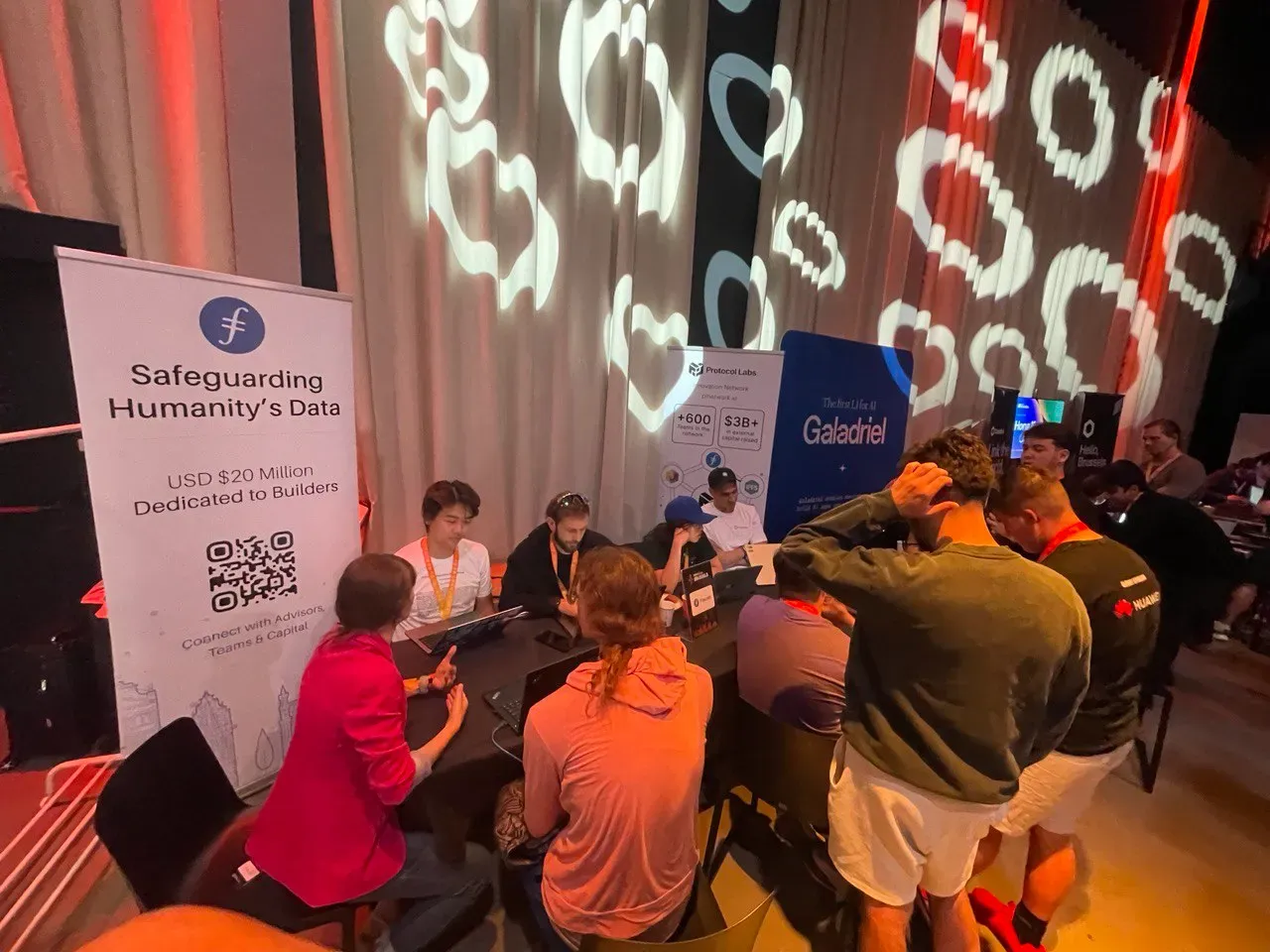
Orchave is a decentralized instant data oracle designed to let users customize APIs, become data providers, and help make offchain data more trustless over time. Presented at ETHGlobal Brussels, the project introduces a provider app for local data contribution and a lightweight verifier network that expands verification through participation rather than relying on a fixed validator set. It won 1st place in the Filecoin prize and also received an Avail prize pool award.

What makes Orchave distinctive is its approach to decentralization. Instead of assuming that data trust must come from a small closed oracle network, Orchave treats decentralization as something that can grow dynamically with usage. As more people rely on a given data source, more verifiers are drawn into the system, increasing confidence in the result. The project reflects node101's interest in infrastructure that is both technically ambitious and economically meaningful: a system where data flows, verification, and participation reinforce one another.
Photon Bridge


Lambda ZK Week
Celestia Celestia
Mina Protocol Mina Protocol

Photon Bridge is a Celestia-Mina data availability bridge built by the node101 team during the Lambda Class ZK Hackathon in Paris in 2023. The project won first place in both the main track and the Mina track by solving one of Mina's core infrastructure problems through the integration of Celestia as a decentralized data availability layer.

Photon Bridge is designed to make zkApps more reliable by ensuring that offchain data remains available, verifiable, and resistant to censorship. Instead of relying on centralized storage solutions, the system uses Celestia for data availability and a signer mechanism to confirm that the required data is accessible across the network. This allows applications built on Mina to preserve liveness even when they depend on external data.

At its core, Photon Bridge is an interoperability project that connects a major zero-knowledge ecosystem with the modular data availability layer of Cosmos. It shows how Celestia can be used to strengthen zk-based systems and opens a new design space for developers building applications that require stronger guarantees around data availability, security, and continuity. Photon continued after the hackathon as a public-good project with contributions from the node101 team.

Wisper


ETHGlobal Brussels
Ethereum Ethereum

Wisper is a privacy-focused communication project built around the idea that messaging should be both private and verifiable. Public project materials describe it as a system for secure, one-to-one communication using Mina Protocol, zero-knowledge proofs, and o1js, with client-side storage and offchain communication replacing centralized message infrastructure.

The project goes beyond simple encrypted chat. Its core ambition is to make communication provable without sacrificing privacy, allowing parties not only to exchange messages securely, but also to prove that a message was sent when needed. That framing makes Wisper less of a messaging app and more of an experiment in zk-enabled private coordination.

For node101, Wisper stands as an example of how zero knowledge can move from abstract cryptography into direct human use cases.

MemeCraft


Mammothon
Celestia Celestia

MemeCraft is an AI-powered meme generation and marketplace platform built on Celestia for the Mammothon. It lets users create, customize, trade, and collect memes inside a Telegram mini app, turning meme creation into a fully onchain-native consumer experience. node101's internal product materials describe it as a verifiable web application built with the Chopin Framework, secured by Celestia's Data Availability layer and designed to make meme culture programmable, collectible, and easy to share. MemeCraft combines AI generation, marketplace mechanics, Telegram-native distribution, and unique ".meme" usernames in one product. The point is not just to generate memes, but to show how Celestia's modular infrastructure can support lightweight, consumer-facing applications with verifiable state transitions and low-cost scalability. In short, MemeCraft turns internet culture into an onchain product.

Democracy Counter


ETHPrague
Ethereum Ethereum

Democracy Counter is a hackathon project focused on making digital voting easier to verify, easier to follow, and easier to trust.

The project approaches democracy not only as an interface problem, but as a counting problem. In any voting system, the real challenge is not just collecting votes, but making sure they are recorded correctly, counted transparently, and reflected in a result that participants can trust. Democracy Counter turns that challenge into a product direction. Instead of treating voting as a black box, Democracy Counter explores a clearer model for digital participation, where the logic of counting is more visible, the process is easier to inspect, and collective decisions become more legible for everyone involved.

At its core, Democracy Counter is about turning civic coordination into something measurable, understandable, and verifiable.

Octopus Layer


ETHDam
Near Near
o1js o1js

Octopus Layer is a chain-agnostic ZK proof verification layer designed to make zk applications easier to build and easier to deploy across multiple blockchains. Built as a proof of concept, it uses NEAR as the settlement layer and combines it with Mina's o1js proof system to create a censorship-resistant verification network for zk proofs. The core idea is simple: developers generate proofs once, Octopus verifies them through a lightweight verifier layer, and the result can then be pushed to other chains.

The architecture is built for developer usability as much as for infrastructure. Proofs can be exported as JSON, verifier nodes are lightweight enough to be deployed even in browsers, and the system is designed to avoid traditional consensus overhead by focusing only on proof verification. Instead of every chain re-solving the same zk integration problem, Octopus creates a shared layer that abstracts verification into a reusable product.

Octopus Layer is ultimately about making zero knowledge portable across blockchain ecosystems.

View More Work

Do you want to build an unordinary product?

Reach us